
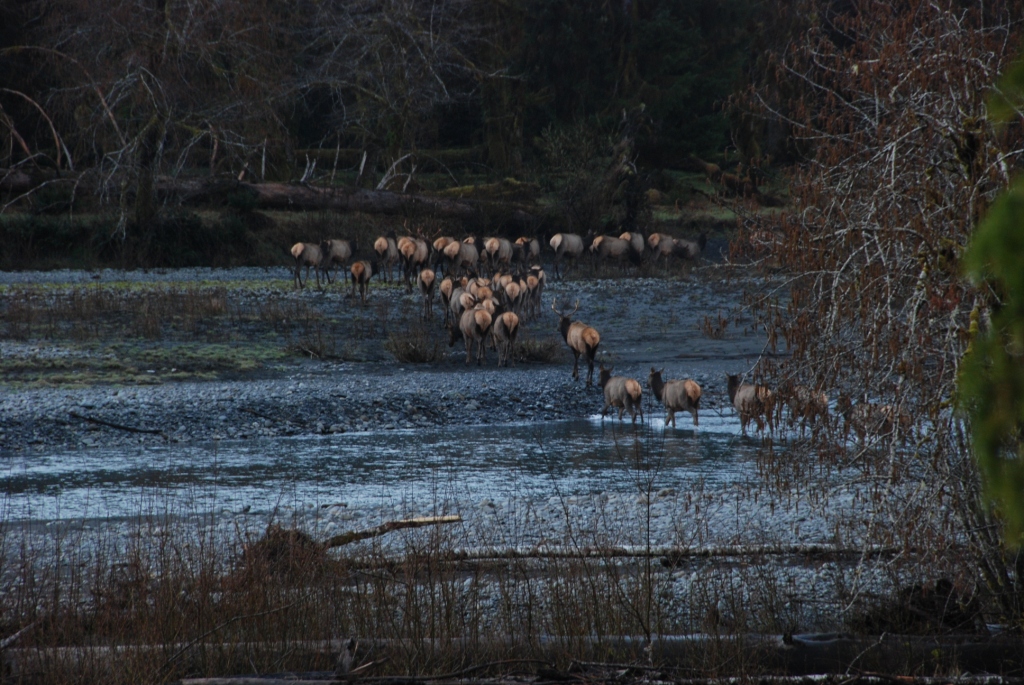
One day in Olympic National Park forces a decision that no other park in the lower 48 demands quite so bluntly: there is no road through the middle. Olympic is roughly a million acres wrapped around a mountain range, and US-101 loops the outside of it like a ring road. Every attraction is a spur road pointing inward. Trying to see the rainforest, the coast, and the mountains in a single day means about seven hours in the car and almost no time outside it.
So the honest advice is to pick one lane. Below are three single-day routes, each built around one ecosystem, plus the one combination that actually works.
Why can't you see all of Olympic in one day?
Distance. From Port Angeles on the north coast, Hurricane Ridge is a 17-mile climb. The Hoh Rain Forest is closer to two hours away. Rialto Beach and the Pacific coast strip are further still, and Lake Quinault sits at the far southwest corner. Driving from Hurricane Ridge to the Hoh and then to the coast is a genuine four-to-five-hour driving day before you have walked a single trail. The park is also not contiguous — the coastal strip is a separate band of land 20-odd miles from the main massif.
Route 1: The rainforest day
This is the choice if you have never seen temperate rainforest, and it is the most distinctive thing Olympic offers. Drive to the Hoh Rain Forest Visitor Center and walk the Hall of Mosses, a 0.8-mile loop through bigleaf maples hung with club moss that is the single most photographed piece of ground in the park. Add the Spruce Nature Trail (about 1.2 miles) for river bottom and Sitka spruce, then walk the first mile or two of the Hoh River Trail to leave the crowds behind.
The Hoh road is a dead end, roughly 18 miles off US-101, and the parking lot fills early on summer weekends — the park has used a queue system at the entrance in busy seasons. Arrive before 9am. Note also that the Hoh road has been closed by washouts in recent winters, so check current road status before committing your only day to it.
Route 2: The coast and lake day
The most varied day for the least driving. Start at Lake Crescent, a startlingly blue glacially carved lake right on US-101, and hike to Marymere Falls — about 1.8 miles round trip from the Storm King ranger station, mostly flat with a short climb at the end. Continue west to Sol Duc Falls, a 1.6-mile round trip to a waterfall that splits into three channels over a mossy gorge.
Finish at Rialto Beach for sunset. The walk north to Hole-in-the-Wall is about 3.3 miles round trip over cobble and driftwood, and it is strictly tide-dependent — you must consult a tide chart and not get caught on the wrong side of a headland. Even if you skip the full walk, Rialto's stacked driftwood and sea stacks are the Pacific Northwest coast at its most cinematic.
Route 3: The mountain day
Hurricane Ridge is the only easy high-country access in the park, topping out around 5,200 feet with views across to Mount Olympus and, on clear days, over to Canada. Trails from the lot — Hurricane Hill (about 3.2 miles round trip) and the Meadow Loops — put you in subalpine wildflowers by mid-summer.
Be aware that Hurricane Ridge has had significant disruption: the day lodge was destroyed by fire in 2023, and road access has been limited, seasonal, and at times restricted to certain days or hours during reconstruction. Check the current-year road and facility status before building a day around it — this is the single most likely thing to derail an Olympic itinerary.
What is the best combination for one day?
If you insist on two ecosystems, pair Lake Crescent with Sol Duc and Rialto Beach (Route 2) — they sit along the same western arc of US-101 and the driving is manageable. The pairing that does not work is Hurricane Ridge plus the Hoh; they are on opposite sides of the range and you will spend the day looking at a windshield.
For context on how Olympic fits into a longer Washington trip, Mount Rainier is about three hours southeast and North Cascades sits north of Seattle — our Washington national parks guide maps the three-park loop. You can browse every unit on the parks directory or see the full Olympic National Park overview.
What should you know before you go?
Bring rain gear regardless of forecast — the Hoh averages well over 100 inches of rain a year and the coast is not much drier. Cell service is absent across most of the park, so download maps and tide charts in advance. Fill your tank in Port Angeles or Forks; gas stations are sparse on the west side. And check whether your entry pass covers the coastal areas, some of which are managed jointly with tribal lands.
FAQ
Is one day enough for Olympic National Park?
One day is enough for one region — the rainforest, the coast, or the mountains — but not for the whole park. Two to three days lets you cover all three without spending the trip driving.
How long does it take to drive around Olympic National Park?
The full US-101 loop around the peninsula is roughly 330 miles and takes about seven hours of pure driving, before any spur roads or stops. There is no road across the interior.
Can you do Hurricane Ridge and the Hoh Rain Forest in one day?
Technically yes, but it is a poor use of a single day. They are on opposite sides of the park and the round trip between them is several hours. Pick one.
What is the best time to visit Olympic National Park?
July through September gives the driest weather, open high-country trails, and reliable road access. Spring and fall are quieter and greener in the rainforest but wetter, and the high country is snowbound much of the year.
Do you need reservations for Olympic National Park?
Olympic has not used a park-wide timed entry system, but popular areas have used queueing or capacity limits in busy periods, and campgrounds book out. Check the current-year rules and road status before your visit.
Which entrance should you use for one day in Olympic?
Port Angeles is the main hub for Hurricane Ridge and Lake Crescent. Forks is the base for the Hoh Rain Forest and Rialto Beach. Choose the town that matches the route you picked.