
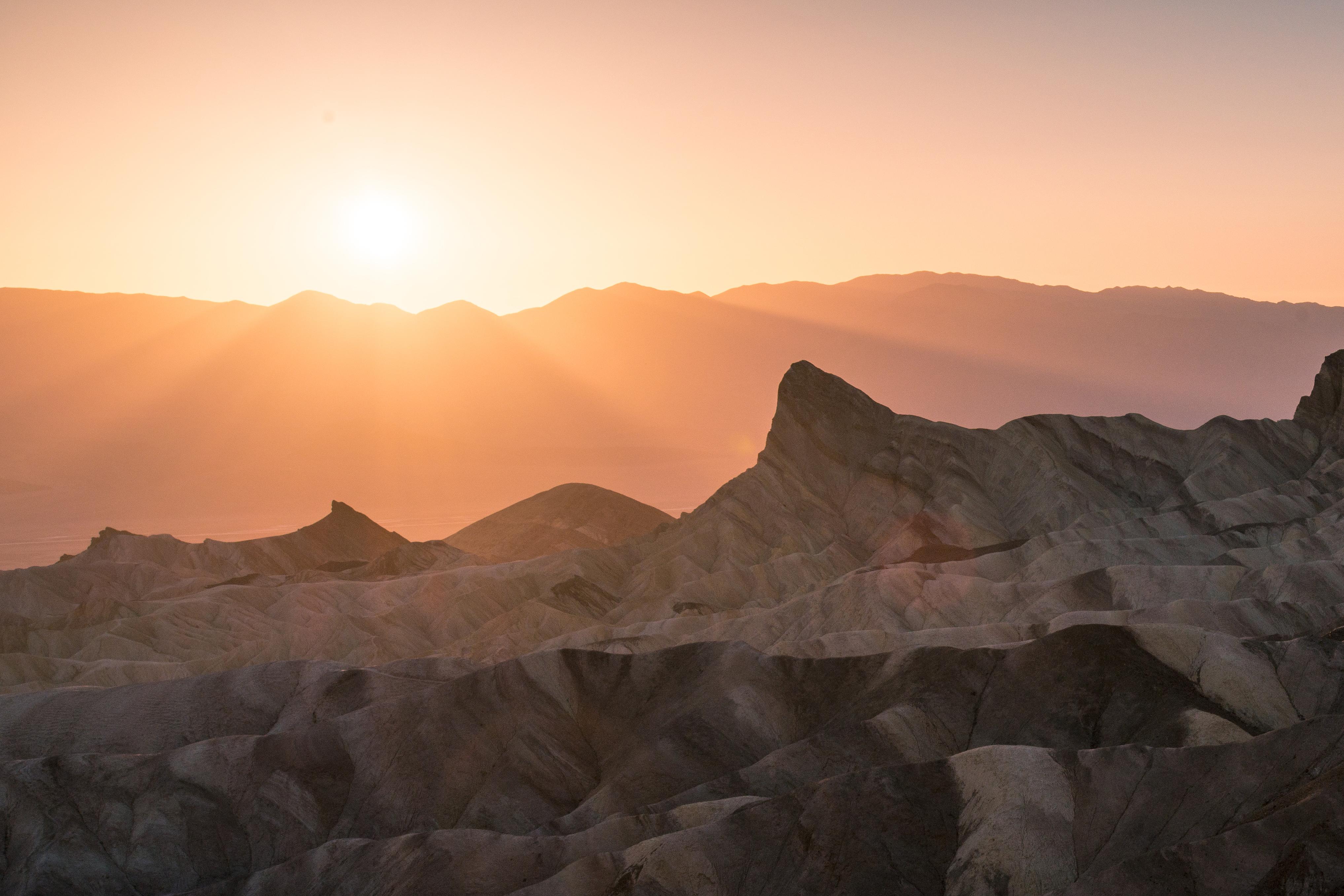
One day in Death Valley National Park is enough to see its greatest hits if you follow the sun: start at Zabriskie Point for sunrise, drive south to Badwater Basin before the heat builds, loop through Artists Drive, and finish at the Mesquite Flat Sand Dunes for sunset. Death Valley is the largest national park in the lower 48, so the key to a good day is keeping most of your time around Furnace Creek and resisting the urge to chase distant corners like the Racetrack or Ubehebe Crater.
What is the best one-day Death Valley itinerary?
This route covers roughly 100 to 130 miles of driving from Furnace Creek and suits a standard passenger car, with no off-road driving required.
Sunrise — Zabriskie Point. A short paved walk leads to the classic view over golden badlands toward Manly Beacon. Arrive 20-30 minutes before sunrise; the color on the ridges is best in the first half hour.
Early morning — Dante's View (optional). About a 25-mile drive south and up to roughly 5,500 feet, this overlook looks straight down on Badwater Basin with the Panamint Range behind it. It is usually far cooler than the valley floor. The final stretch is steep and narrow, with length limits for large vehicles, so check current restrictions if you drive an RV.
Mid-morning — Badwater Basin. Walk out onto the salt flats at 282 feet below sea level, the lowest point in North America. Go at least half a mile past the boardwalk to reach the crisp hexagonal salt polygons.
Late morning — Natural Bridge and Devil's Golf Course. Natural Bridge is a short gravel-road detour and an easy, roughly 1-mile round-trip walk up a canyon. Devil's Golf Course is a quick stop to see jagged salt pinnacles up close.
Early afternoon — Artists Drive. A one-way, 9-mile paved loop through multicolored hills. Stop at Artists Palette, where mineral deposits tint the slopes green, pink and purple. The road has a vehicle length limit, so check current rules.
Midday break — Furnace Creek. Refuel, eat, visit the visitor center and its museum, and wait out the hottest hours indoors. Harmony Borax Works, a few minutes north, is a quick look at the park's mining history.
Late afternoon — Golden Canyon or Mosaic Canyon. If temperatures allow, walk the first mile of Golden Canyon near Furnace Creek, or Mosaic Canyon's polished marble narrows near Stovepipe Wells.
Sunset — Mesquite Flat Sand Dunes. The most accessible dunes in the park, right off the highway near Stovepipe Wells. Walk out 15-20 minutes to get away from footprints and catch long shadows on the ridgelines.
How do you avoid the heat in Death Valley?
Heat is the single biggest factor in planning a day here. Summer air temperatures on the valley floor regularly exceed 110°F, and ground temperatures run far higher. From roughly May through September, the park advises against hiking at low elevations after 10 a.m. In those months, compress this itinerary into sunrise and sunset, stay close to your car midday, and treat Dante's View as your "hike" since it is cooler at altitude. Carry at least a gallon of water per person, even if you plan only short walks, and do not rely on your phone: cell coverage is patchy across most of the park. From November through March, midday temperatures are usually comfortable and you can hike through the day.
Where should you start if you are driving from Las Vegas?
Most day-trippers come from Las Vegas, about two hours from Furnace Creek via Pahrump and Death Valley Junction. To catch sunrise at Zabriskie Point, you would need to leave Las Vegas very early, so many travelers flip the order: arrive mid-morning, do Badwater, Natural Bridge and Artists Drive, rest at Furnace Creek, then end with sunset at the dunes before the drive back. If you can, spend the night in the park at Furnace Creek or Stovepipe Wells, or in Beatty, Nevada, just outside the east entrance, to get both golden hours without a pre-dawn drive.
What should you know before you go?
Fuel: Gas is available at Furnace Creek, Stovepipe Wells and Panamint Springs, but it is expensive and stations are far apart. Enter with a full tank.
Entrance fee: There are no staffed booths on some routes, so pay online or at the visitor center. Check the current-year fee rules.
Road closures: Flash floods periodically close or damage roads, including Badwater Road and Artists Drive. Check current road conditions before you leave.
What to skip in one day: Scotty's Castle, the Racetrack and Ubehebe Crater are far to the north and eat half a day or more of driving.
Want more time here? See the best hikes in Death Valley, our guide to the best time to visit Death Valley, and Death Valley vs Joshua Tree. For more trip planning, visit the Death Valley park page, nearby Joshua Tree and Great Basin, every park in California and Nevada, or browse all national parks.
FAQ
Is one day enough for Death Valley National Park?
One day is enough to see the core highlights around Furnace Creek: Zabriskie Point, Badwater Basin, Artists Drive and the Mesquite Flat Sand Dunes. You will need two or three days to add remote areas like Ubehebe Crater, the Racetrack or longer canyon hikes.
Can you do Death Valley as a day trip from Las Vegas?
Yes. Furnace Creek is about two hours from Las Vegas, making a long day trip very doable. Leave early, carry plenty of water, and fill your tank before you enter the park.
What is the one thing you should not miss in Death Valley?
Badwater Basin. Standing on the salt flats at 282 feet below sea level, with mountains rising more than 11,000 feet on the western skyline, is the park's signature experience.
Can you visit Death Valley in summer?
You can, but plan around the heat. Sightsee from your car or at high-elevation viewpoints during the day, avoid low-elevation hikes after 10 a.m., and carry extra water. Spring, fall and winter are far more comfortable.
Do you need a 4x4 for a one-day Death Valley trip?
No. Every stop in this itinerary is reachable in a standard car on paved or well-graded gravel roads. High-clearance or 4x4 vehicles are only needed for backcountry routes such as the Racetrack.