
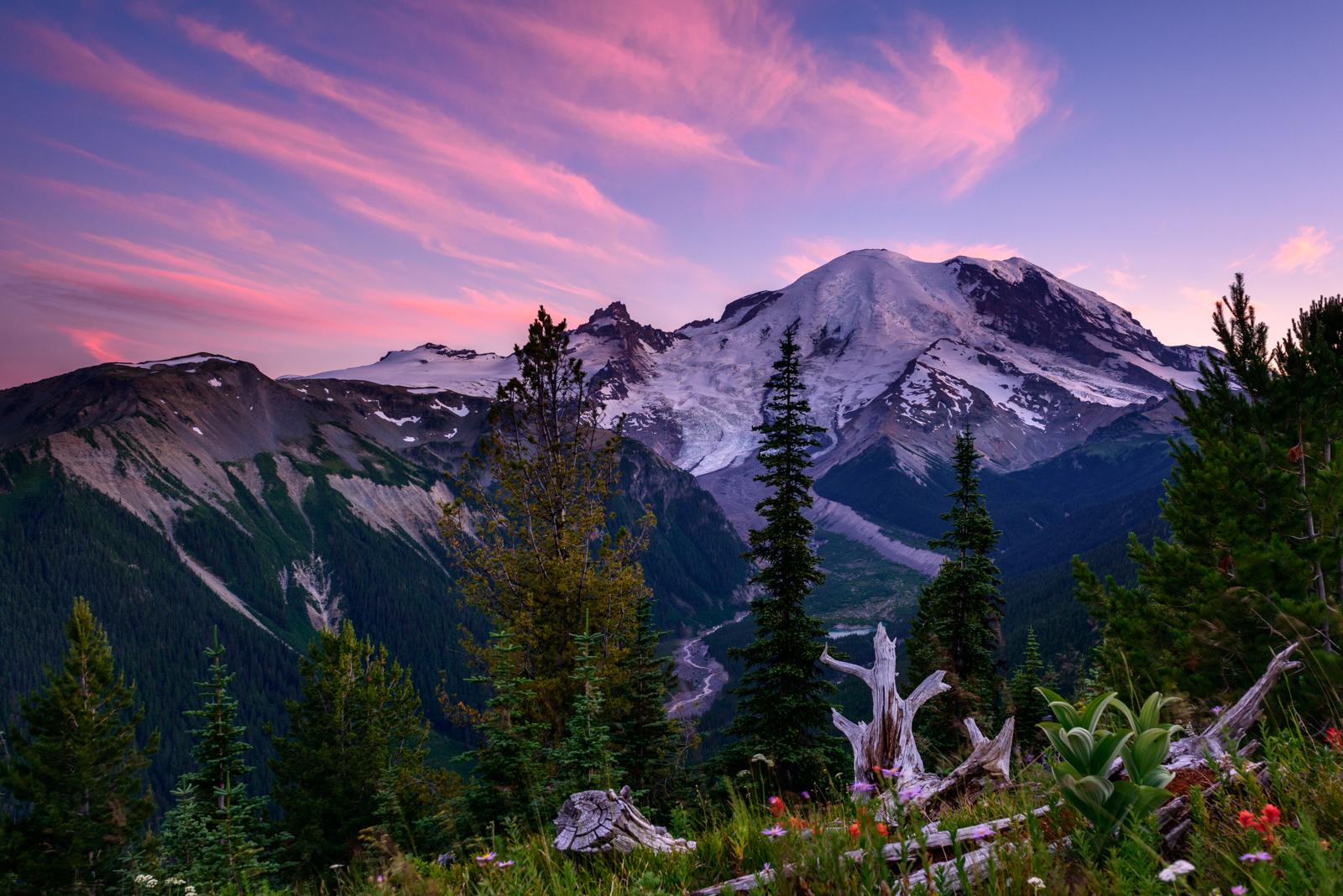
Deciding between Mount Rainier vs North Cascades comes down to what kind of Washington wilderness you want: an iconic glaciated volcano ringed by wildflower meadows, or a rugged, roadless maze of jagged peaks and turquoise lakes. Both are within a few hours of Seattle, yet they offer completely different experiences. This guide breaks down access, hiking, crowds, and scenery so you can pick the right one, or plan a road trip that includes both.
What is the main difference between the two parks?
Mount Rainier is built around a single massive 14,410-foot stratovolcano, and nearly everything you do orbits that peak, from the Paradise wildflower meadows to the Sunrise viewpoints. North Cascades is a sprawling sea of sharp granite summits and hanging glaciers with very few roads, giving it a remote, alpine feel closer to the Canadian Rockies. Rainier is about one unforgettable mountain; the North Cascades is about endless mountains stretching to the horizon. You can compare both on our Mount Rainier National Park and North Cascades National Park pages.
Which park is easier to visit?
Mount Rainier is the easier day trip. It has developed visitor hubs at Paradise and Sunrise, paved scenic roads, historic lodges, and clearly marked trails, making it welcoming for families and first-timers. North Cascades has almost no services inside the park core; most visitors experience it by driving the North Cascades Highway and pulling over at viewpoints like Diablo Lake, then hiking in from the roadside. If you want lodging, dining, and infrastructure close at hand, Rainier is the clear winner.
Which park has better hiking?
Both are superb, but they suit different hikers. Rainier's Skyline Trail, Naches Peak Loop, and Tolmie Peak deliver wildflowers and glacier views on well-graded, well-signed paths. The North Cascades reward stronger hikers with steep, jaw-dropping routes like Cascade Pass, Maple Pass Loop, and Sahale Arm. If you want maximum scenery per step of effort and do not mind a hard climb, the North Cascades are hard to beat; if you want reliable, family-friendly trails, choose Rainier.
Which is better for scenery and solitude?
North Cascades is one of the least visited national parks in the country, so solitude is easy to find even in summer. Its glacier-carved valleys and vivid glacial lakes feel wild and untouched. Rainier is far busier, and Paradise parking fills early on summer weekends. For crowd-free grandeur, the North Cascades win; for the single most iconic mountain view in Washington, Rainier delivers. Travelers often add a coastal day at Olympic National Park to round out a Washington trip.
Which one should you choose?
Choose Mount Rainier if it is your first visit, you are traveling with family, or you have only a day and want guaranteed wow factor and easy logistics. Choose North Cascades if you crave solitude, love strenuous alpine hiking, and want scenery that feels genuinely remote. With three to four days you can comfortably do both, since they are only about a two-hour drive apart. Plan the wider route with our Washington parks guide and give yourself extra time for unpredictable mountain weather.
FAQ
Can you visit Mount Rainier and North Cascades in one trip?
Yes. They are roughly two hours apart, so many travelers base near Seattle and dedicate a couple of days to each over a long weekend.
Which park is less crowded?
North Cascades is dramatically less crowded and consistently ranks among the least visited national parks, while Mount Rainier draws large summer crowds at Paradise and Sunrise.
When is the best time to visit?
Mid-July through September offers the best trail access and wildflowers at both parks. High-country snow lingers into summer, and the North Cascades Highway closes in winter, so check current-year conditions before you go.