
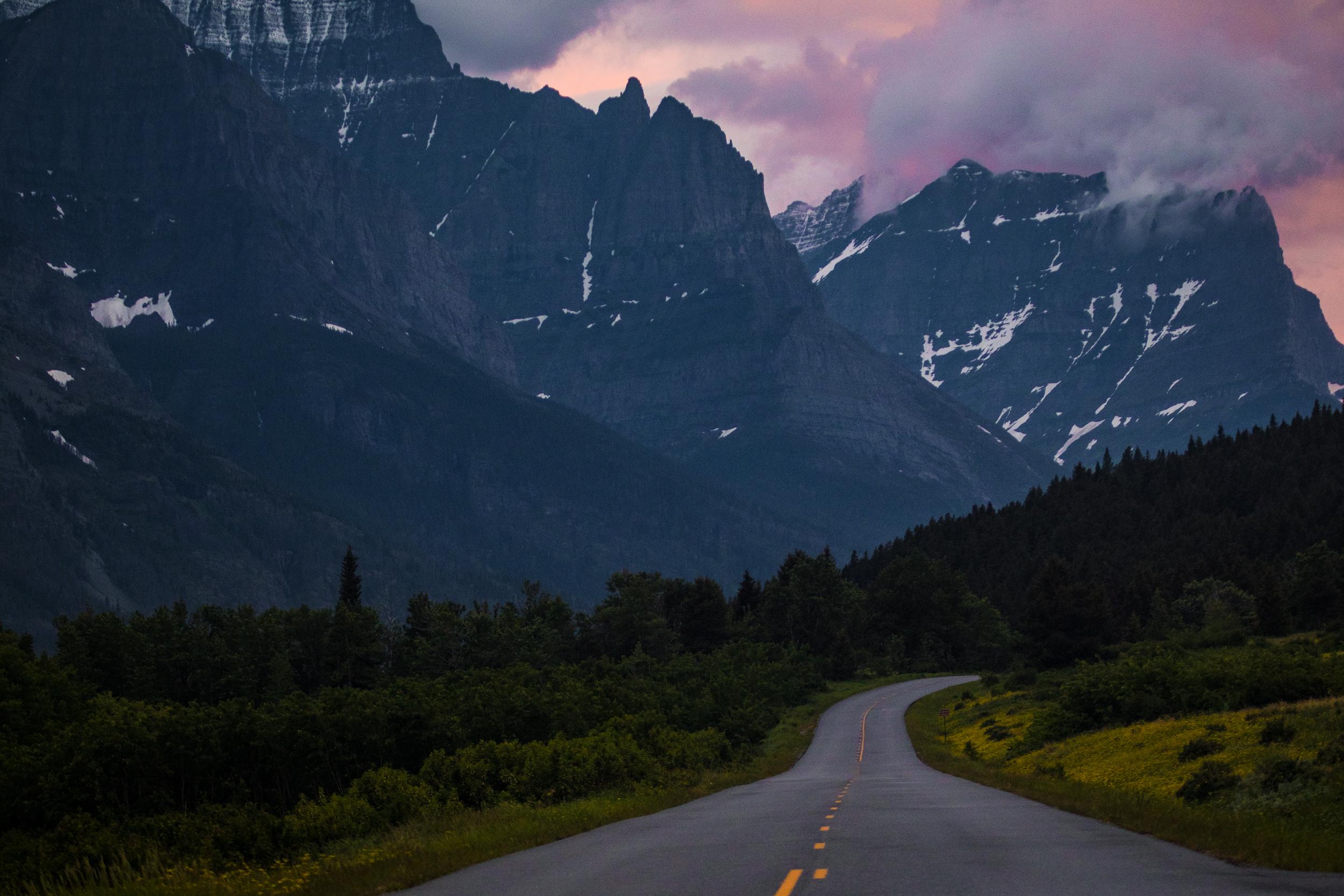
The Highline Trail is the signature day hike of Glacier National Park: roughly 11.8 miles one way from Logan Pass to The Loop, following the Garden Wall along the Continental Divide with barely any climbing for the first several miles. Most people hike it point-to-point, downhill overall, using the park shuttle to get back. It is not a loop, and planning the return is the part hikers most often get wrong.
How long is the Highline Trail and how hard is it?
The full point-to-point route runs about 11.8 miles from the Logan Pass trailhead to The Loop on the Going-to-the-Sun Road, with roughly 800 feet of gain and around 3,400 feet of net descent. That profile is deceptive: the elevation gain is modest, but the distance is real, the sun exposure above treeline is constant, and the final four miles down to The Loop are a relentless switchbacking descent that punishes knees.
Plan on 6 to 8 hours at a moderate pace with stops. Strong hikers do it in 5. If you add the Grinnell Glacier Overlook spur, add another 1.6 miles and 1,000 feet of climbing, plus at least an hour.
What is the ledge section really like?
About a quarter mile past the Logan Pass trailhead, the trail cuts across a cliff face with a drop on the downhill side and a garden hose-style hand cable bolted into the rock wall. This is the section that shows up in every photo and every nervous forum post.
In practice the tread is roughly four to five feet wide — wide enough to pass someone — and the cable is there for reassurance more than necessity. It lasts only a few hundred yards. But if exposure genuinely bothers you, this is where you will know, and it is early enough that turning back costs you almost nothing. Nobody should talk you past it.
Should you hike it one way or out and back?
One way, downhill, from Logan Pass to The Loop is the standard and the best use of the day. The alternative that many people prefer is an out-and-back from Logan Pass to Haystack Pass — about 7.6 miles round trip — which captures the most scenic stretch of the Garden Wall, skips the brutal descent, and returns you to your own vehicle.
Hiking up from The Loop to Logan Pass is the least pleasant option: 3,400 feet of climbing through a burn scar with little shade. Avoid it unless shuttle timing forces your hand.
Is the Grinnell Glacier Overlook spur worth it?
Yes, if you have the legs. The spur leaves the Highline about 7.6 miles in and climbs roughly 0.8 miles straight up scree to a notch in the Garden Wall, where you look down onto Grinnell Glacier and the turquoise meltwater lakes of the Many Glacier valley — a view you otherwise only earn by hiking the Grinnell Glacier Trail from the other side of the divide.
It is short but steep and loose. Do it only if you are comfortably ahead of your shuttle window.
How do the shuttle and parking work?
Logan Pass parking fills extremely early in summer — often before 7 a.m. The reliable approach is to park at a lower lot and ride the free park shuttle up to Logan Pass, hike to The Loop, and catch the shuttle back down to your car. Doing it in that direction means a missed shuttle at the end is an inconvenience rather than a stranding.
Vehicle reservations for the Going-to-the-Sun Road corridor and shuttle operating dates are set annually and have changed repeatedly in recent years — check the current-year rules before you commit to a date. Our Montana national parks guide and the full park directory cover entrances and fees.
When is the Highline Trail open?
The trail is snow-covered and closed for most of the year. It typically opens sometime in early-to-mid summer once crews clear the ledge section, and stays passable into early fall. The opening date swings by weeks depending on snowpack, and the trail can close temporarily for bear activity at any point in the season.
Early season means lingering snowfields on the traverse; late season means the best wildflower-to-larch color transition and thinner crowds. Verify the current-year opening status the week of your hike rather than relying on last year's date.
What should you bring?
Bear spray, accessible on your hip and not buried in your pack — this is prime grizzly habitat and the Highline crosses open slopes where sightlines are good but encounters happen. Beyond that: three liters of water (there is no reliable treated source), sun protection for a fully exposed traverse, a wind layer for the Divide, and trekking poles for the descent to The Loop. Cell service is unreliable.
FAQ
Do you need a permit for the Highline Trail?
No permit is required for day hiking the Highline. You do need park entry, and a vehicle reservation may be required for the Going-to-the-Sun Road corridor depending on the current-year system. Overnight stops at Granite Park Chalet or the backcountry campground are separate reservations.
How exposed is the Highline Trail ledge?
The cliff-side section is only a few hundred yards long, near the start, with a hand cable and a tread wide enough for two-way traffic. It is genuinely intimidating to look at and manageable to walk. Because it comes so early, you can assess it and turn around with minimal lost effort.
Can you hike the Highline Trail with kids?
The Haystack Pass out-and-back suits capable older kids and teens. The full 11.8-mile point-to-point is a long day for most children, and the ledge section makes it a poor fit for younger ones. Judge by attention span on exposure, not just fitness.
Where does the Highline Trail end?
At The Loop, a hairpin turn on the Going-to-the-Sun Road about 4 miles below Logan Pass by road. There is a shuttle stop and limited parking there. Granite Park Chalet sits about 4 miles before the end and is a common rest stop.
Is the Highline Trail better than Grinnell Glacier?
They are different experiences. The Highline is a long, mostly level traverse with continuous big-country views along the Divide. Few trails anywhere hold that much scenery for that little climbing. Grinnell Glacier is a shorter, steeper climb to a single dramatic destination. If you only have one day and hate descents, choose Grinnell.