
The best time to visit Olympic National Park is mid-July through late September, when Hurricane Ridge Road is reliably open, the high country has melted out, and the Pacific coast gets its longest stretch of dry days. That said, Olympic is really three parks stacked into one peninsula — rugged coast, temperate rainforest, and glaciated mountains — and each one peaks at a different moment. Picking your season is less about finding "good weather" and more about deciding which of those three landscapes you came for.
Why does Olympic have such different weather in one park?
The Olympic Mountains create one of the sharpest rain shadows in the Lower 48. The Hoh Rain Forest on the west side absorbs roughly 12 to 14 feet of precipitation a year. Sequim, barely 40 miles northeast, gets under 20 inches — desert numbers. Practically, this means a washed-out forecast for the coast can coexist with dry, clear trails on the northeast side around Deer Park and Blue Mountain. If a storm rolls in, driving east rather than cancelling is often the better call.
When is Hurricane Ridge Road actually open?
Hurricane Ridge is the park's most-visited viewpoint and the biggest single variable in trip planning. The road typically opens to full daily access from late spring through fall, and drops to limited winter days — often Friday through Sunday only — once snow arrives, with tire chains required in the vehicle regardless of whether you have all-wheel drive. Closures for avalanche control and storms happen on short notice. Check the current-year road status and winter operating schedule the morning you go rather than trusting a schedule published months earlier.
What is each season like?
Summer (July–September): The one window where everything is simultaneously accessible. Subalpine wildflowers at Hurricane Ridge peak roughly late July into early August. Trailhead parking at Hurricane Ridge, Sol Duc, and the Hoh regularly fills before 9 a.m. in August, and the Hoh has used a queue-and-hold system on busy days.
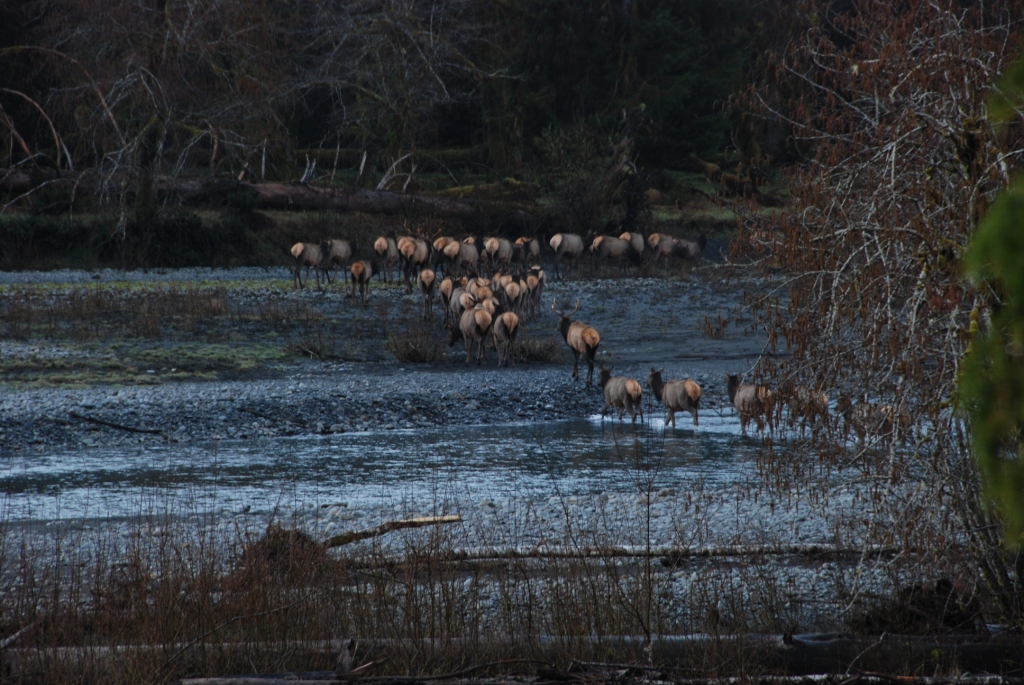
Fall (October–November): Bigleaf maples in the Hoh and Quinault valleys turn gold in mid-to-late October, and crowds thin sharply after Labor Day. Roosevelt elk enter their rut in September and October, which makes the Hoh and Quinault valleys unusually good for wildlife. Rain returns in earnest by November.
Winter (December–March): The rainforest is at its most convincing — moss saturated, rivers loud, and often nearly empty. Hurricane Ridge becomes a small ski and snowshoe area on its limited-access days. Many high-elevation trails are unreachable.
Spring (April–June): Waterfalls run hardest, but mountain trails hold snow well into June. This is the strongest season for the coast and low-elevation river valleys.
When should you visit the Olympic coast?
The coastal strip has its own clock, and it is tidal rather than seasonal. Rialto Beach's Hole-in-the-Wall and the sea-stack headlands south of Third Beach require a low tide to pass safely, and several sections of the wilderness coast have headlands that are impassable at high water. Consult a tide table for your specific date and give yourself a wide margin — people get cliffed out here every year. Summer offers the best odds of clear evenings for sunset over the sea stacks; winter delivers the storm-watching and the driftwood.
How many days do you need?
Three days is the realistic minimum to see all three ecosystems, because Olympic has no road through its center — everything loops around US 101, and the drive from the Hoh to Hurricane Ridge is roughly two and a half hours. A tight three-day plan is one day on the coast, one in the rainforest, one in the mountains. Two days forces you to drop one. If you have a week, add Sol Duc, Lake Ozette, and the Quinault valley.
If you are comparing Washington's parks, see our guides to Olympic National Park, Mount Rainier National Park, and North Cascades National Park, or browse everything in Washington. You can also see the full list of national parks by state.
FAQ
What is the least crowded time to visit Olympic National Park?
Mid-October through April is the quietest stretch, with January and February the emptiest. Late September is the best compromise — noticeably thinner crowds while Hurricane Ridge Road and most high trails are still open.
Does it rain constantly in Olympic National Park?
Not in summer. July and August are the driest months across the peninsula, and the northeast side near Port Angeles stays comparatively dry all year because of the rain shadow. The rainforest reputation comes from the west-side valleys in the October-to-March window.
Is Olympic National Park worth visiting in winter?
Yes, if you go for the rainforest and the coast rather than the mountains. Winter delivers empty trails, dramatic storm surf, and the Hoh at its greenest. Expect limited Hurricane Ridge access and carry chains.
Do you need a reservation to enter Olympic National Park?
Olympic does not use a park-wide timed-entry system, but wilderness camping permits are required and popular quotas such as the Ozette coast and Sol Duc–Seven Lakes Basin sell out quickly. Check the current-year permit and fee rules before you go.
When do wildflowers bloom at Hurricane Ridge?
Typically late July into early August, shifting a week or two either direction depending on the winter snowpack.