
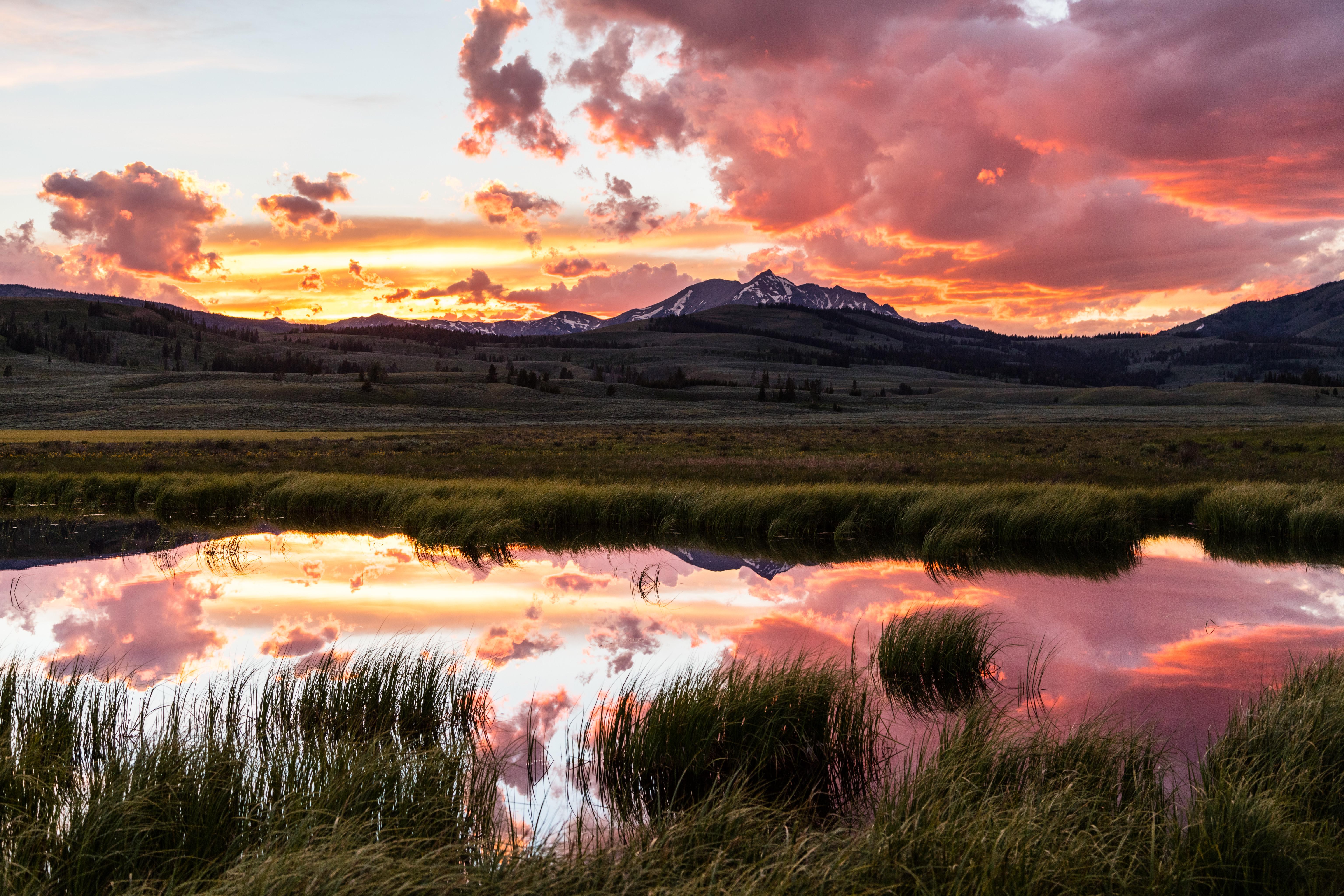
With one day in Yellowstone National Park, the only itinerary that actually works is the Lower Loop: enter at West Yellowstone, drive clockwise through Old Faithful and Grand Prismatic Spring, cross Hayden Valley, and finish at Artist Point above the Lower Falls. That is roughly 100 miles of driving and about 11 hours door to door. Trying to add Mammoth Hot Springs or Lamar Valley on the same day is what turns a great day into a blur of parking lots.
Why does the Lower Loop beat the Upper Loop in one day?
Yellowstone's figure-eight road system splits into two loops of about 70 and 96 miles. The Lower Loop holds the park's signature geothermal features — Old Faithful, Grand Prismatic, the Fountain Paint Pot, Mud Volcano — plus the Grand Canyon of the Yellowstone. The Upper Loop is quieter and beautiful, but its highlights (Mammoth Hot Springs, Tower-Roosevelt, Lamar Valley) are spread much further apart. If you only get one day, the Lower Loop gives you far more per mile driven.
Speed limits inside the park top out at 45 mph and drop to 25 mph in developed areas. Bison jams routinely add 20 to 40 minutes with no warning. Budget your day around an average of 30 mph, not 45.
What does the hour-by-hour schedule look like?
6:30 a.m. — Enter at West Entrance. Arriving before 8 a.m. is the single highest-value decision of the day. The Madison River corridor often has elk and bison in the early light, and the Old Faithful lot is still half empty.
7:45 a.m. — Old Faithful. Check the predicted eruption time posted at the visitor center. While you wait, walk the boardwalk loop to Castle Geyser and Morning Glory Pool rather than sitting on the benches.
10:00 a.m. — Midway Geyser Basin and Grand Prismatic. Park at Fairy Falls trailhead instead of the Midway lot and hike the 1.2-mile round trip to the Grand Prismatic Overlook. From the boardwalk you see steam; from the overlook you see the colors. This is the detail most one-day itineraries skip and the reason most visitors leave disappointed by their photos.
12:15 p.m. — Lunch and Fountain Paint Pot. Grab food at Old Faithful before leaving or pack it; dining options thin out fast on the eastern half of the loop.
1:30 p.m. — West Thumb Geyser Basin. A compact half-mile boardwalk with hot springs sitting directly on the shore of Yellowstone Lake. Forty minutes is plenty.
3:00 p.m. — Hayden Valley and Mud Volcano. The best roadside wildlife viewing in the park. Pull fully into a turnout, stay 25 yards from bison and elk and 100 yards from bears and wolves.
4:30 p.m. — Grand Canyon of the Yellowstone. Drive the South Rim to Artist Point for the classic view of the 308-foot Lower Falls, then Uncle Tom's Overlook. Late-afternoon light hits the canyon walls better than midday.
6:30 p.m. — Exit via Norris back to West Yellowstone, or continue north if you are staying inside the park.
Where should you stay the night before?
West Yellowstone, Montana sits at the West Entrance and puts you inside the park within minutes of leaving your room — the best base for a single-day visit. Gardiner, Montana works if you are combining Yellowstone with the Upper Loop, and Jackson, Wyoming makes sense only if you are pairing this with Grand Teton National Park. Rooms in all three book out months ahead in July and August; check the current-year availability early.
What should you pack for a single day?
Layers, and more water than feels necessary. Most of the loop sits between 7,000 and 8,000 feet, where mornings near freezing and afternoons in the 70s happen on the same day. Bring a full tank of gas — stations exist at Old Faithful, Canyon and Grant Village, but lines are long. Cell service is effectively absent outside developed areas, so download offline maps before you enter.
Is one day in Yellowstone actually worth it?
Yes, if you accept that you are sampling rather than exploring. Yellowstone is 2.2 million acres, larger than Rhode Island and Delaware combined. One day on the Lower Loop shows you the geothermal systems and the canyon, which is genuinely the park's core. What you will miss is the backcountry, the Upper Loop's terraces, and the unhurried wildlife watching that makes people come back. Many visitors treat a one-day trip as a scouting run and return for three or four days later.
FAQ
How many hours do you need for the Lower Loop?
Plan for 10 to 12 hours including stops. The driving alone is about 3.5 hours at realistic park speeds, and the six main stops need roughly 45 minutes each.
Which entrance is best for a one-day Yellowstone trip?
The West Entrance at West Yellowstone, Montana. It drops you 14 miles from Madison Junction and directly onto the Lower Loop, with the most lodging within walking distance of the gate.
Can you see Old Faithful and Grand Prismatic in the same morning?
Yes. They are 7 miles apart on the same road. Old Faithful first, then Grand Prismatic via the Fairy Falls trailhead overlook, works well before 11 a.m.
Do you need a reservation to enter Yellowstone?
Yellowstone does not use a timed-entry system, unlike some parks. You still need an entrance pass or an America the Beautiful pass. Check the current-year rules before you travel, since reservation policies change between seasons.
What is the best time of year for a one-day visit?
Late May through early June, or September. Roads are open, crowds are lighter than midsummer, and wildlife is active. See our guide to the best time to visit Yellowstone National Park for a month-by-month breakdown.
Planning more time in the park? Start with the best hikes in Yellowstone National Park, browse the full Yellowstone National Park guide, or see everything worth visiting in Wyoming and Montana.